01AI agents
AI agents: work is starting to not need a computer
AI agents now have their own computer in the cloud. What that means for people who work from their phone, how work may change and how to prepare.
In August 2026, xAI launched Grok Bot, a team of agents that works on its own computer in the cloud. Seven weeks later, OpenAI introduced dots, ChatGPT agents that also have their own computer and work all day. At the same time, Microsoft is preparing Agent 365 to manage agents inside companies, Google offers an agent platform for Gemini Enterprise and Anthropic is bringing Claude to work with files and applications.
Behind all these announcements there is an idea worth looking at calmly: computer work is starting to separate from the person who owns the computer.
What changed with agents
Until recently, AI answered questions. You asked for a text, a summary or an idea, and the rest of the work was still yours: open the system, copy the data, send the email, update the spreadsheet.
This generation of agents does that rest. Three traits set them apart:
- Their own computer. They work on a machine in the cloud, with a browser and access to the apps you connect. They do not depend on your laptop being on.
- Continuous work. They do not wait for you to write. They pursue a goal, make progress for hours or days and check in when they need a decision.
- Teamwork. Several agents can split tasks, talk to each other and coordinate, like a small team.
What this means for people who do not work at a screen
A large share of working people do not spend the day in front of a computer. Technicians visiting customers, salespeople on the road, drivers, site supervisors, shop owners, health workers, farmers. They all have a phone, but many administrative tasks force them to sit at a screen at the end of the day, or to depend on someone who does it for them.
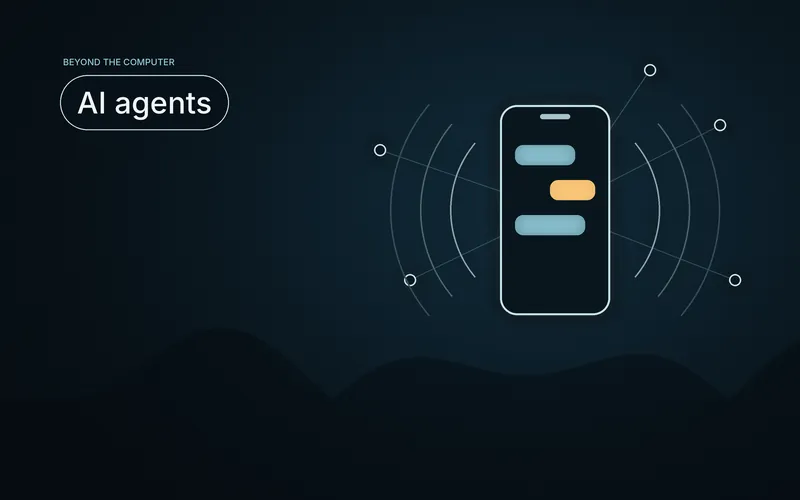
Agents change that equation. If the agent has its own computer and understands instructions by message or voice, the person no longer needs one to delegate the work:
- A technician finishes a visit, leaves a voice note about what was done, and the agent files the report, updates the spare-parts stock and sends the invoice.
- A salesperson messages the agent to prepare the proposal for the customer they just visited, with updated prices.
- A shop owner gets a daily summary of sales and pending orders, and approves supplier payments with a reply.
This is not science fiction. Dots already accept voice calls and messages from Slack or Teams, and OpenAI has announced SMS support. Grok Bot is managed through messages from your phone. The computer still exists, but it moves to the cloud and the agent uses it.
What is not solved yet
The shift is real, but it is worth not getting ahead of it:
- Agents make mistakes. Both OpenAI and xAI recommend reviewing work with important consequences. Human supervision is still necessary.
- Permissions matter. An agent that signs into your accounts needs clear rules about what it can do alone and what needs approval.
- Privacy depends on the vendor. You need to know what data is stored, where and with which controls.
- Not everything can be delegated. Judgment, customer relationships and hard decisions remain human work.
- Connectivity and cost count. For many small businesses, plan prices and connection quality will set the pace of adoption.
Where it is heading
Nobody can say for sure what work will look like in five years. What is visible is the speed: in less than two months, two products appeared that change how we use AI, and new models built for long-running agents arrive every few weeks.
For many tasks, the question will probably stop being "which program do I use?" and become "which agent do I ask?". For people who today need a computer only for paperwork and data entry, that may mean less time at a screen and more time on the work that really matters. For others, the computer will remain their main tool, now with digital colleagues working in parallel.
The option stays open, and both worlds will probably coexist for quite a while.
How to prepare
You do not need to wait for everything to settle to start:
- Identify recurring tasks that today force someone to sit at a screen.
- Organize your information. Agents work better with connected systems and clean data. We explain why in from isolated tools to connected systems.
- Test with a narrow case, with limited permissions and human approval on important steps.
- Measure and adjust before expanding.
To learn about both launches in detail, read our articles on Grok Bot and OpenAI dots. And if you want to think about how to apply agents in your company, let's talk.